
How Signal Flow Works
Every EMS video wall follows the same basic path, whatever the scale: Capture → Process → Display.
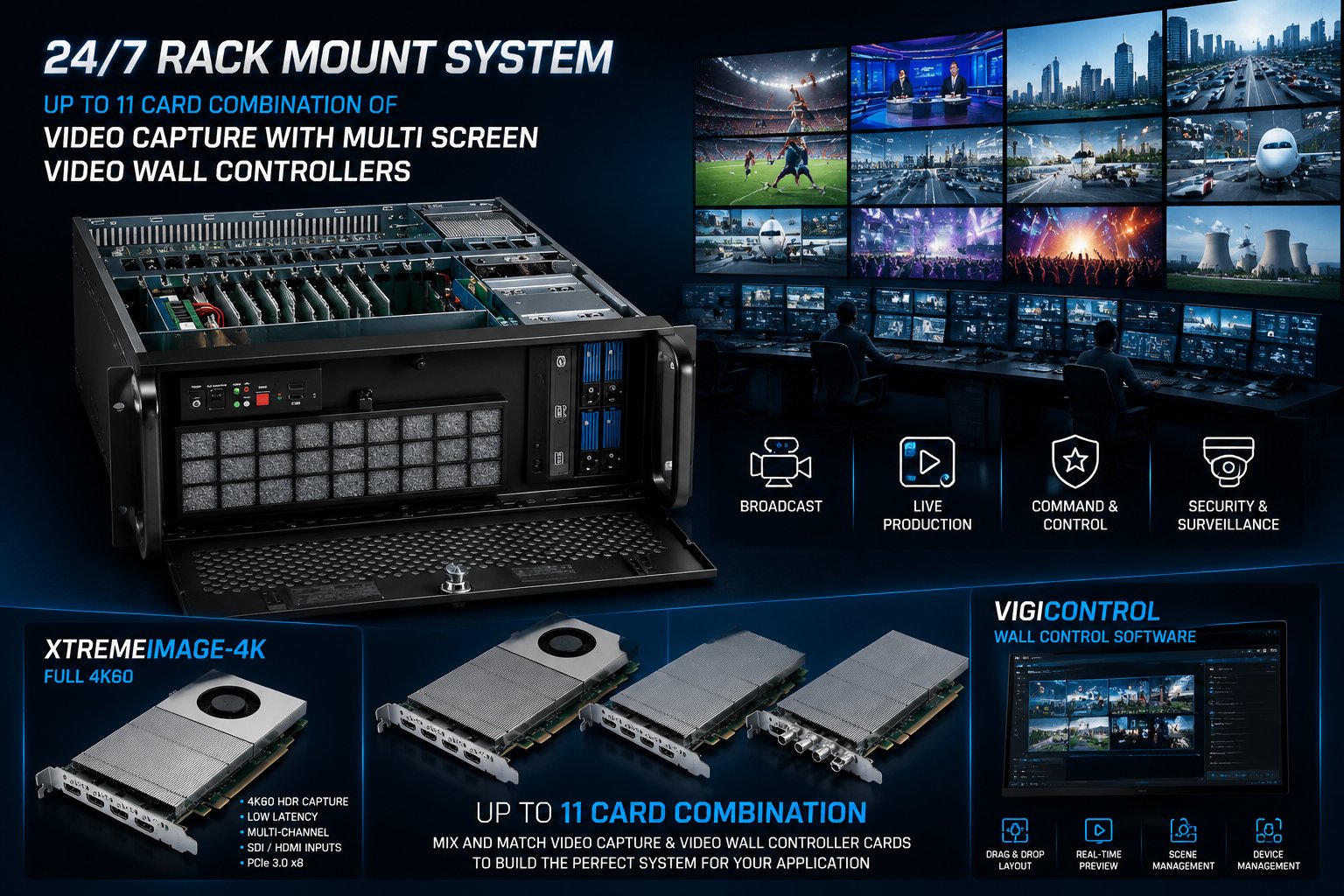
A Xtreme capture card (or an Active SQX card for IP/network streams) brings each source signal into the system, converting it into a format the host can work with and triple-buffering it in onboard memory for tear-free output. From there, VigiControl 10 handles placement — deciding which region of the wall each source appears in, at what size, and whether it's part of a saved layout template. Finally, an XtremeImage graphics card renders that composed output across the physical displays, with EMS's driver handling bezel correction, rotation and multi-screen spanning so the wall reads as one continuous canvas rather than a grid of separate monitors.
On a VSN chassis system, all of this happens inside one box; on larger installations, a VSNV3 Expansion Chassis extends the same signal path across multiple physical chassis with full gen-locking, so there's no visible seam between a card in the master unit and a card in an expansion chassis three slots away.
See XtremeImage graphics cards for the output side of this path, or choosing a VSN chassis to size the system that runs it.